
Introduction
If you are planning to buy property, open a bank account, or set up utilities, getting your NIE number in Mallorca is typically the first administrative step that unlocks everything else.
The NIE (Número de Identidad de Extranjero) is your foreign identification number in Spain. It is required for many legal and financial actions connected to ownership and everyday life, from signing a deed to arranging services in your name.
For international buyers who value certainty and clear sequencing, the NIE is best treated as part of a structured setup process, handled early so the rest of your purchase and ownership timeline can move forward without unnecessary delays.
See what it’s like living in Mallorca like a local ⇒
The Quick Process for Getting Your NIE
You generally complete the NIE process by preparing the core documents, paying the fee, booking an appointment, and attending in person to submit and collect the certificate.
Prerequisites: What You’ll Need
| Item | Notes |
| Valid passport | Bring the original and a copy of the photo/ID page. |
| EX-15 form | Standard NIE application form, complete it before your appointment. |
| Modelo 790-012 (fee form) | Complete it and pay the corresponding fee following the form instructions. |
| Proof of reason for application | Supporting document showing why you need an NIE (for example, property purchase-related paperwork). |
| Passport photos | Have recent passport-style photos available if requested. |
Quick Steps Overview
- Prepare your documents (passport, EX-15, Modelo 790-012, and proof of purpose).
- Pay the Modelo 790-012 fee and keep the payment receipt.
- Book an NIE appointment with the relevant office in Mallorca, then confirm you have every required copy.
- Attend the appointment in person to submit your application, then follow the office instructions to collect the NIE certificate.
Step-by-Step Guide to the DIY Application in Mallorca
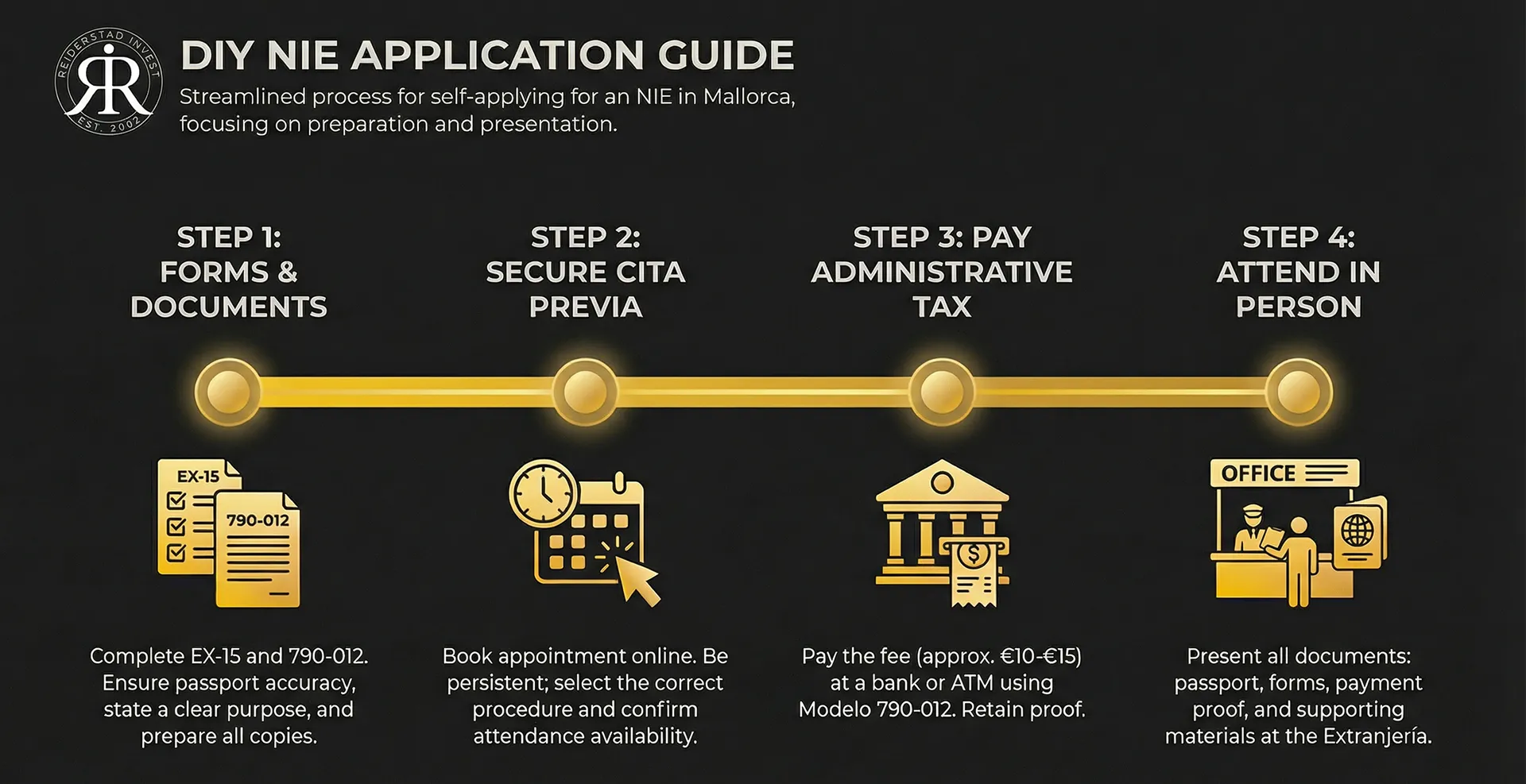
If you are applying yourself (without a representative), the core flow is: prepare forms and supporting documents, secure a cita previa, pay the fee, then present everything in person. Small mismatches, like an unsigned form or missing copies, are common reasons for delays.
Step 1: Complete the Official Forms (EX-15 and 790-012)
EX-15 is the standard NIE request form, and Modelo 790-012 is the fee form used to generate and pay the administrative tax.
Practical points to get right before you book anything:
- Match your passport exactly: Use the same name order, spelling, and passport number as shown on your passport.
- State a clear purpose: Your reason for requesting an NIE should align with the supporting document you plan to submit (for example, property purchase-related paperwork).
- Prepare supporting documents and copies: Bring originals plus copies unless the appointment instructions state otherwise.
- Translations: If you are submitting foreign documents, they may need an official Spanish translation. If you are unsure, confirm requirements before the appointment so you do not lose your slot.
Step 2: Book the ‘Cita Previa’ (Appointment)
A cita previa is the online appointment booking used for many immigration and police procedures. In Palma, securing a slot can be notoriously difficult, so plan for multiple attempts and do not leave it to the last minute.
To keep this step controllable:
- Try booking at different times of day and on different days; availability can change without notice.
- Ensure you select the correct procedure for an NIE request; choosing the wrong category can make your appointment unusable.
- Only book once you can attend in person with the full document set; missed appointments can set you back.
If your broader plan includes residency paperwork later, be aware that address registration (empadronamiento) can be a separate bottleneck for some procedures. It is not the NIE itself, but it can affect your overall timeline if you are sequencing multiple registrations.
Step 3: Pay the Administrative Tax at a Bank
You must pay the NIE administrative tax before your in-person appointment. The amount is typically in the €10 to €15 range, and it is paid using the Modelo 790-012.
Common ways payment is handled in practice:
- Bank counter: Take the completed Modelo 790-012 to a local bank and pay at the counter.
- Bank ATM: Some banks allow payment at an ATM using the form details.
Keep proof of payment; you will usually need to present it with your application packet.
Step 4: Attend Your Appointment at the Extranjería
On the day you attend the designated location listed in your booking, typically a police station handling foreign documentation or the Oficina de Extranjería, and submit your application in person.
Bring a clean, organized set of documents:
- Your passport (original) and copies
- Completed EX-15
- Completed Modelo 790-012 plus proof of payment
- Supporting document(s) showing the reason for your NIE request
- Any additional items specified in the appointment confirmation (for example, photos if requested)
At the appointment, staff will check the paperwork and either accept it for processing or ask for corrections. Follow the instructions you receive for how and when to collect the NIE certificate, collection is often a separate step and may require returning in person.
The Stress-Free Alternative: Applying via Power of Attorney

Many international buyers, especially those coordinating a property purchase from abroad, choose not to run the NIE process themselves. Instead, they appoint a local professional (often a gestor or lawyer) to handle the application end-to-end, reducing appointment friction and avoiding in-person administrative logistics.
In practice, this is done by granting a Power of Attorney (Poder), so your representative can act on your behalf. If you sign the Poder outside Spain, it is typically notarized and then legalized for use in Spain with a Hague Apostille.
This approach is often preferred when you want certainty in the timeline and less dependency on securing scarce appointments. It also reduces the risk of minor document errors that can trigger rejection or rescheduling, and it can remove the need to attend early queues or multiple office visits in Mallorca.
A clean way to evaluate whether a Power of Attorney is the right fit:
- Your availability: If you are not on the island, or you have limited flexibility to attend an appointment in Palma during office hours.
- Your risk tolerance: If you want a professional to verify forms, supporting documents, copies, and submission requirements before anything is filed.
- Your wider purchase timeline: If the NIE is a gating item for downstream steps such as banking, notary signing, and utilities.
For clients working with Reiderstad Invest, this managed route aligns well with a structured acquisition process: the NIE is treated as a prerequisite milestone that can be delegated and tracked, rather than an open-ended administrative task that competes with property viewings, negotiations, and travel planning.
EU vs. Non-EU Citizens: Understanding the TIE
It is easy to confuse three concepts: the NIE number (an identification number used for tax and administrative purposes), EU registration (a residency registration certificate), and the TIE (a physical residency card for non-EU nationals). You can have an NIE without being a resident, but residency processes often generate or formalize your NIE as part of the file.
The Certificado de Registro (EU Citizens)
If you are an EU citizen and plan to stay in Spain for more than 3 months, you generally need the Certificado de Registro. This is the green paper certificate that registers you as an EU resident in Spain.
How it relates to the NIE:
- The NIE is still your identification number for Spanish administration.
- The EU registration is a residency step, it is not just an NIE assignment.
- In many real-life scenarios, EU citizens first obtain an NIE for property or banking, then complete EU registration once they decide to reside in the EU longer-term.
If you are residing in Spain under a specific basis (for example, as a family member of a Spanish national), authorities may expect you to follow the residency route rather than applying for a standalone NIE only. In that context, the residency application is typically what anchors your NIE within the file.
The TIE Card (Non-EU Citizens)
If you are a non-EU citizen (including many UK and US buyers), the TIE (Tarjeta de Identidad de Extranjero) is the physical residency card issued once you have an approved status that requires it. It is different from the NIE: the TIE is proof of your right to reside under a particular permit, and it will display your NIE.
A common sequencing point to understand:
- If you enter Spain on a visa that requires a TIE, you generally apply for the TIE within 30 days of arrival.
- Before applying for a TIE, you typically need an Empadronamiento (Padrón) registration, which is your municipal address registration.
This distinction matters for planning. A standalone NIE can support property purchase logistics, but if your real goal is to live in Spain under a non-EU permit, the TIE timeline and the empadronamiento prerequisite become part of your critical path.
Where Are the NIE Offices in Mallorca?
In Mallorca, NIE appointments are typically handled either through the main Oficina de Extranjería in Palma or through designated Comisaría de Policía (police stations) that process foreign documentation. The specific location depends on the procedure you select when booking and the appointment availability shown in the system.
Do not plan to arrive without a confirmed cita previa. Walk-ins are generally not accepted, and staff will usually direct you back to the online appointment system. Before traveling to the appointment, double-check the exact office address shown on your booking confirmation and bring the complete document set required for that procedure.
Find a list of offices following this link ⇒
Common Pitfalls That Delay the NIE Process
Small administrative gaps are the most common reason an otherwise straightforward NIE appointment turns into a reschedule. The issues below are all avoidable with a strict document check before you leave.
- Missing the printed cita previa confirmation: Many offices expect the exact appointment confirmation page (printed), and may not accept a screenshot alone.
- Incorrect or incomplete Modelo 790-012 payment proof: Paying the tax is not enough; you typically need the right receipt or bank-stamped proof, and it must be clearly linked to your application.
- Insufficient passport copies: Bring the original passport plus photocopies, including any pages the office asks for. Turning up with only the photo page can cause delays if the desk requires additional pages.
- No official Spanish translation for supporting documents: If you rely on foreign documents to justify your NIE request, the office may require an official Spanish translation. Without it, they can refuse the submission even if everything else is in order.
What Your NIE Unlocks in Mallorca
The NIE is not a lifestyle document, but in practice, it is the administrative key that lets you act like an owner in Spain. Once you have it, many downstream steps become straightforward because you can be properly identified in contracts, banking, and government systems.
Key milestones your NIE typically enables in Mallorca include:
- Signing a property deed (escritura) and completing purchase formalities: The NIE is commonly required to appear on notary documents and related filings when you buy.
- Opening a local bank account: Many buyers need a Spanish account for purchase completion and recurring payments tied to ownership.
- Setting up utilities and services in your name: Electricity, water, internet, and other contracts often require an NIE for the account holder.
- Buying and registering a vehicle: Ownership, registration, and related administrative steps frequently rely on your NIE.
For a high-intent buyer, the value is less about the number itself and more about removing friction so you can focus on the reasons you came to Mallorca. That might mean closing on an exclusive villa in Son Vida with confidence in the timeline, arranging a berth at the Club de Mar marina in Palma without administrative bottlenecks, or setting up a family base near the Rafa Nadal Tennis Academy in Manacor with practical essentials, like banking and utilities, handled cleanly.
Next Steps: Structuring Your Mallorca Property Purchase

Securing your NIE is a practical starting point, but it is only one milestone in a well-sequenced Mallorca purchase. Once the identification and basic administration are in place, the focus typically shifts to structuring the acquisition correctly, aligning the legal and financial steps with your intended use (private enjoyment, long-term planning, or investment).
A deliberate next phase often includes coordinating banking, notary timing, legal due diligence, and a clear plan for the property after completion, including any design, renovation, or rental strategy. The goal is to avoid fragmented handovers where decisions made at purchase create operational problems later.
Reiderstad Invest supports international buyers as an integrated partner through the full lifecycle, from acquisition guidance and practical setup through to interior design, project management, rental strategy, and ongoing property management. If you want a structured plan that connects the administrative essentials with the real-world ownership experience, it can be worth aligning these steps early, rather than solving them one by one.
Explore a collection of luxury properties for sale in Mallorca ⇒
Frequently Asked Questions About the Spanish NIE
How long does it take to get an NIE in Mallorca?
It depends mainly on how quickly you can secure a cita previa (appointment) and whether your documents are accepted without corrections. For many applicants, the appointment availability is the real bottleneck, not the submission itself.
Once you have an appointment, processing and collection timing can vary by office and procedure. The safest approach is to build buffer time into any property, banking, or travel timeline that depends on the NIE.
Does a Spanish NIE number expire?
No, the NIE number itself does not expire. It is your identification number in Spain and remains the same over time.
However, the paper certificate or document that shows your NIE can have practical validity limits depending on the context. For example, residency documentation can require updates as your status changes, and some institutions may ask for a recently issued certificate as proof, even though the underlying number is permanent.
Can I get an NIE without traveling to Spain?
Yes, in some cases, you can obtain an NIE without traveling by appointing a legal representative in Spain via Power of Attorney, so they can apply on your behalf. This is a common solution for buyers coordinating a property purchase from abroad.
Another possible route is applying through a Spanish consulate or embassy, but documents issued abroad may not meet every in-Spain requirement for every institution or follow-on procedure. If you need the NIE for a specific purpose, confirm in advance whether an in-country certificate is required.