

Key Highlights
- Real estate financing in Mallorca can be a strategic choice, even for cash buyers, because it helps preserve liquidity and optimise capital allocation.
- Spain remains attractive for international buyers due to competitive mortgage conditions compared with other European and Anglo markets.
- For non-resident buyers, Wealth Tax in the Balearic Islands becomes relevant on properties valued over €3 million, and mortgage debt is deductible, potentially reducing the taxable base.
- Spanish regulation caps certain early repayment costs, which can give buyers more flexibility to adjust strategy later.
- Working with a specialist partner can simplify cross-border structuring, negotiation, and execution with Spanish lenders.
Introduction
The island’s vibrant real estate market, characterized by high demand, makes it a top destination for property seekers. While you might have the funds to cover the full purchase price, considering financing for your Mallorca property can be a smart financial move.
For many buyers, the smartest decision is not only which property to purchase, but also how to structure the acquisition. In Mallorca’s international market, financing can be a strategic move, even for cash buyers.
Lionsgate Capital, our exclusive financing partner, supports international buyers with tailored mortgage solutions designed to optimise luxury property acquisitions in Spain.
Benefits of Real Estate Financing in Mallorca
Opting for property financing in Mallorca can be one of the best decisions you make when buying a home. It’s not just for those who can’t afford a cash purchase; it’s a strategic tool that can provide significant financial advantages. A mortgage loan can help you manage your funds more effectively and open doors to better opportunities.
Real estate financing allows you to leverage the bank’s capital to secure your dream property while keeping your own money free for other ventures. Let’s explore the top reasons why getting a mortgage in Mallorca is a great idea.
How to buy a home in Mallorca ⇒
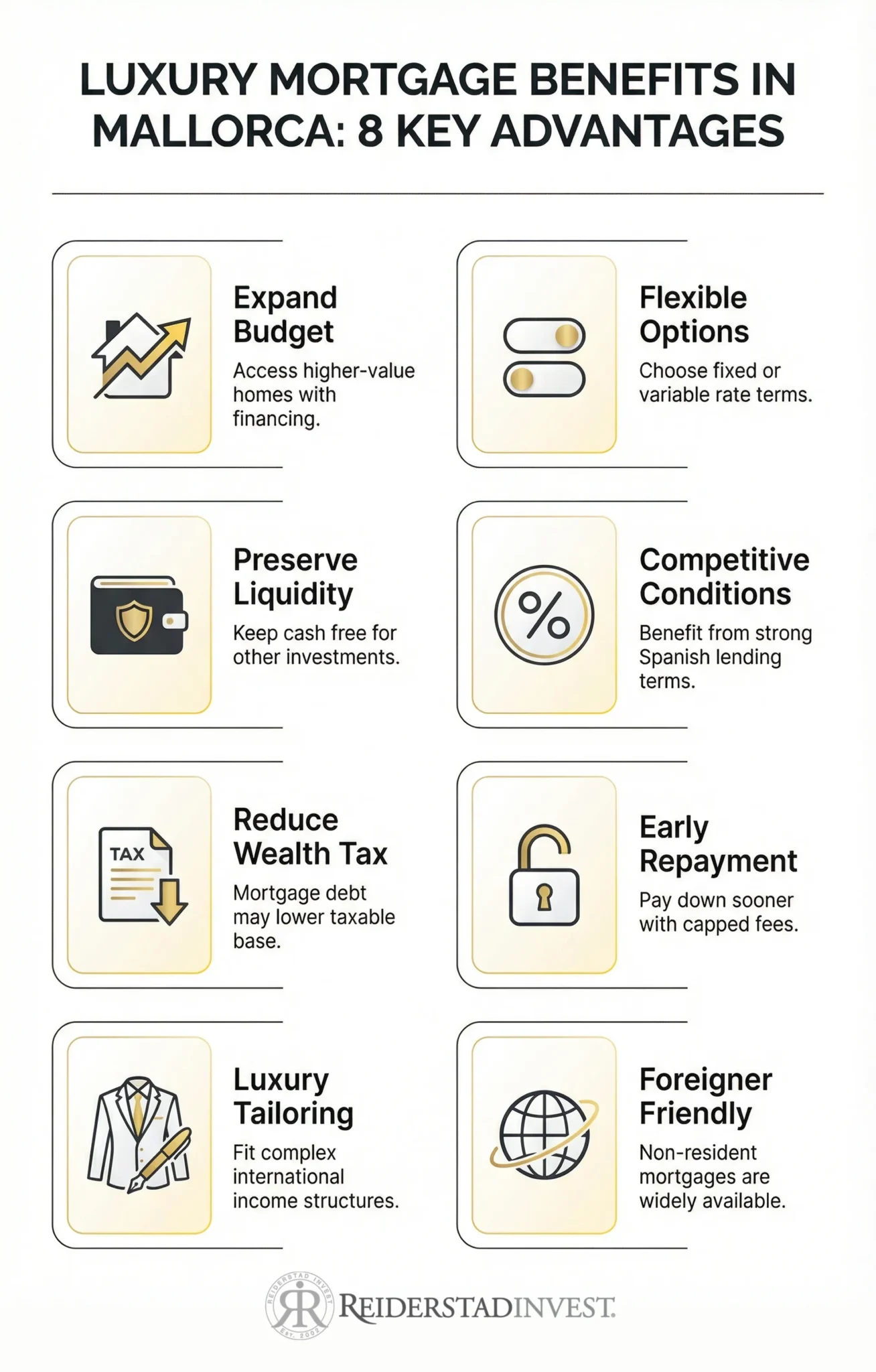
1. Expand Your Budget for a Dream Home

One of the most significant advantages of financing is the ability to stretch your budget. Instead of being limited by the cash you have on hand, a mortgage allows you to consider a wider range of properties, including those that might have previously seemed out of reach.
This means your dream property with stunning sea views or a prime location could become a reality. By securing financing to cover a significant portion of the purchase price, buyers can access higher-value properties in a market where prices have risen by around 32% since 2020, particularly in prime locations.
Financing a luxury property follows a similar process, though lenders may have specific requirements for higher loan amounts. The key is demonstrating a strong financial profile. This expanded purchasing power is a major reason why buyers choose to finance their real estate investments.
2. Flexible Mortgage Options in Mallorca
The Spanish banking system provides a variety of mortgage options to suit different financial situations and preferences. Whether you value stability or are comfortable with market fluctuations, you can find a product that works for you. This flexibility makes financing an attractive path for many buyers.
The most common choices are a fixed-rate or a variable-rate mortgage. A fixed interest rate ensures your monthly payments remain the same throughout the term of the loan, offering predictability.
On the other hand, a variable interest rate fluctuates with market indexes like the Euribor, which could mean lower payments initially but comes with more risk.
3. Preserve Your Liquidity and Investment Portfolio
Tying up all your capital in a single property purchase can be a risky move. By using a mortgage, you can preserve liquidity and optimise capital allocation, keeping flexibility for other investments, business opportunities, or portfolio strategy. This approach keeps your finances flexible.
Instead of liquidating your investment portfolio to fund a property purchase, financing allows your other assets to continue growing. This diversification is a cornerstone of sound financial planning. Over the past decade, Mallorca real estate has delivered an average real (inflation-adjusted) return of around 5% per year, supporting the case for using leverage rather than concentrating capital in a single asset.
Keeping cash on hand also simplifies managing related expenses, such as property taxes and maintenance, without financial strain. It allows you to enjoy your new home with the peace of mind that comes from having a solid financial cushion.
4. Competitive Mortgage Conditions in Spain

Mallorca’s appeal as an investment hub is partly due to the competitive interest rate environment for mortgages. Spain remains attractive for international buyers thanks to competitive mortgage conditions, especially compared to other European and Anglo markets.
With the right lender selection and professional support, financing can be structured efficiently, particularly in a market that saw price growth of approximately 15% year-on-year in 2024, the strongest increase in a decade.
5. Reduce Wealth Tax exposure
For non-resident buyers, Spain’s Wealth Tax becomes relevant in the Balearic Islands on properties valued over €3 million. A key advantage of financing is that mortgage debt is deductible, which can reduce the taxable base and help optimise the overall structure of the purchase.
However, tax laws are complex and can change. To make the most of this benefit, it is highly recommended to consult with a professional tax advisor who understands the nuances of Spanish tax law. They can help you structure your property purchase to be as tax-efficient as possible.
Start with a free consultation with one of our expert agents ⇒
6. More Flexibility Through Early Repayment Options

Compared to other countries, Spain can offer greater flexibility for early mortgage repayment, with certain costs capped by regulation. This gives buyers more control if they decide to sell, refinance, or adjust their financial strategy later.
7. Tailored Financing for Luxury Purchases and International Profiles
Spanish lenders are familiar with international demand in Mallorca, but luxury financing is rarely a standard process. International buyers often need solutions that consider multiple jurisdictions, different income structures, and long-term tax planning. Working with a specialist team can simplify the structuring, negotiation, and execution.
To ensure a smooth process, it’s wise to seek professional advice from an experienced real estate agent or a mortgage broker specializing in the local market. They can guide you toward lenders who have favorable terms for luxury properties and second homes, simplifying your journey to ownership.
8. Opportunities for Foreign Buyers to Invest
Mallorca warmly welcomes foreign buyers, and the financing system is set up to accommodate international investors. Foreign buyers now account for approximately one-third of all property purchases in the Balearic Islands, with non-resident demand concentrated in the mid-to-upper segments of the market. Spanish banks have clear eligibility requirements for non-residents, making it a straightforward process for many nationalities to secure a mortgage.
While residents can often borrow up to 80% of a property’s value, non-residents can often finance 60–70%, depending on profile and property. The main requirements include providing proof of income, having a good credit history in your home country, and showing you have the funds for the down payment and associated costs.
Working with a dedicated mortgage broker or a knowledgeable real estate agency can be incredibly helpful. They understand the specific documentation needed for international buyers and have established relationships with banks, helping you find the best conditions and navigate the application process with ease.
Understanding Mortgage Options in Mallorca

When you decide to pursue real estate financing in Mallorca, you’ll find several types of mortgages available. Understanding the tax obligations and differences between these mortgage options is key to choosing the right one for your financial situation. A Spanish mortgage generally falls into one of a few main categories.
Each type of financing comes with its own set of pros and cons, from the stability of payments to the potential for lower long-term costs. Below, we’ll explore the most common types of mortgages offered by Spanish banks to help you make an informed decision.
Fixed-Rate vs. Variable-Rate Mortgages
The two primary mortgage types you’ll encounter are fixed-rate and variable-rate. A fixed-rate mortgage locks in a specific interest rate for the entire loan term. This means your monthly payment never changes, providing you with predictability and peace of mind, which is ideal for budget-conscious buyers.
In contrast, a variable-rate mortgage is tied to a benchmark index, usually the Euribor, plus a margin set by the bank. Your mortgage rates are recalculated periodically, typically every six or twelve months. This can lead to lower initial payments if the Euribor is low, but your payments could rise if the index increases.
Choosing between them depends on your risk tolerance and financial outlook. Here’s a simple comparison:
| Feature | Fixed-Rate Mortgage | Variable-Rate Mortgage |
|---|---|---|
| Interest Rate | Stays the same for the entire loan term. | Fluctuates based on the Euribor index. |
| Payment Stability | High. Monthly payments are constant. | Low. Monthly payments can change. |
| Risk Level | Low. Protected from interest rate hikes. | High. Exposed to market rate changes. |
| Best For | Buyers who prioritize predictable payments. | Buyers with high income or planning for early repayment. |
Interest-Only and Buy-to-Let Mortgages
If you are familiar with mortgage products from other countries, you might wonder about interest-only or buy-to-let mortgages. In Spain, these types of mortgages are not commonly offered by traditional banks. The standard mortgage products focus on principal and interest repayment.
An interest-only mortgage, where you only pay the interest for a set period, is rare in the Spanish market for residential properties.
When applying for a mortgage in Mallorca, keep these points in mind:
- Many lenders primarily assess affordability based on verified income and existing commitments; treatment of rental income varies by bank and profile.
- Your affordability is based on your existing debt-to-income ratio from your primary sources of income.
- The focus is on standard repayment mortgages, such as fixed-rate or variable-rate options.
Steps to Secure Property Financing in Mallorca
Securing a mortgage in Mallorca involves a clear, step-by-step process. Knowing what to expect can make your buying process much smoother and less stressful. The first step is always to assess your financial standing and understand what you can realistically afford before you start viewing properties.
From getting pre-qualified to signing the final purchase contract, each stage requires careful attention. Working with a mortgage broker can streamline these real estate transactions, as they guide you through the requirements and paperwork. Let’s look at the key steps involved.
Pre-qualification and Initial Requirements
Getting a mortgage approved in principle is a crucial first step. This pre-qualification confirms your borrowing limit, giving you a clear budget for your property search and showing sellers that you are a serious buyer. It involves an initial assessment of your financial profile by a lender or broker.
The eligibility requirements are fairly standard. Lenders will want to see a stable financial history and sufficient income to cover the new mortgage payments alongside your existing debts. A good credit history in your home country is also essential.
To get started, you will generally need to meet these initial criteria:
- Provide proof of income through recent pay slips and tax returns.
- Open a Spanish bank account, which is necessary for the transaction.
- Have a clean credit history with no outstanding defaults.
Choosing the Right Mortgage Provider
You have two main paths for finding a mortgage: approaching a local bank directly or using a mortgage broker. Walking into a bank branch is an option, but it limits you to the products offered by that single institution, which may not be the best fit for you.
A specialist financing partner can act as a single point of contact, working with leading banks in Spain and private banking institutions across other jurisdictions. Lionsgate Capital supports international clients through the full financing journey, from strategy and structuring to negotiation and execution, helping secure competitive terms and a smooth process.
Ultimately, the choice depends on your personal preferences. If you value expert guidance and want to ensure you get the best deal possible, a broker is an excellent choice. They manage the entire process, from application to completion, ensuring a smooth experience.
Essential Documents for Mortgage Applications
When you’re ready to submit your mortgage application, you’ll need to gather a comprehensive set of documents. Lenders require this paperwork to verify your identity, assess your financial stability, and evaluate the property you intend to buy. Having everything in order will speed up the approval process significantly.
These documents typically fall into two categories: personal financial records and property-related legal documents. From proof of income to the official valuation of the property, each piece of information helps the bank make its final decision. Here’s a closer look at what you’ll need.
Proof of Income and Financial Status
Demonstrating your ability to repay the loan is the most critical part of your application. Lenders need to see clear proof of income and a healthy financial situation. This involves providing several key documents that paint a picture of your earnings and expenses.
For employees, this typically means submitting your last few months’ pay slips and your most recent income tax return. If you are self-employed, you will need to provide more extensive documentation, including your business accounts and tax returns for the last two years.
You will also need to provide bank account statements for the last three to six months. These statements help the bank verify your income and assess your monthly spending habits. The general rule is that your total monthly debt payments, including the new mortgage, should not exceed 35-40% of your net monthly income.
Property Valuation and Legal Documents
Once the bank has assessed your financial profile, the next step is the valuation of the property, which reflects the true value of the property. This must be carried out by an independent valuation company certified by the Bank of Spain. The lender will use the lower of the purchase price or the valuation amount to determine the maximum loan they will offer.
Alongside the valuation, you will need to provide several important legal documents related to the property. These documents confirm the legal status of the property and the terms of the sale.
Key documents include:
- The property’s land registry extract (Nota Simple), detailing ownership and any registered charges or encumbrances.
- A copy of the private purchase contract (contrato de arras) signed with the seller.
- Your Spanish foreigner’s identity number (NIE).
Conclusion
Financing remains a strategic tool for international buyers in Mallorca, particularly in a market where property values have increased by over 70% during the past decade, reinforcing long-term capital preservation and flexibility. If you are considering a luxury purchase, Lionsgate Capital, Reiderstad Invest’s exclusive financing partner, can help structure the purchase efficiently with a bespoke mortgage solution.
The Lionsgate Capital Expertise

Lionsgate Capital acts as a single point of contact, working with leading banks in Spain and private banking institutions across other jurisdictions. The team supports international clients through the full financing journey: from strategy and structuring to negotiation and execution, ensuring access to the most competitive terms and a smooth, efficient process from start to finish.
Luxury financing is not a standard mortgage process. International buyers often require solutions that take into account multiple jurisdictions, different income structures and long-term tax considerations. That is why working with a specialist team like Lionsgate Capital is essential.
Mortgage Calculator
Financing your property purchase is always a smart decision!
If you are considering buying a luxury property in Mallorca, Lionsgate Capital can help you structure the purchase efficiently with a bespoke mortgage solution designed for you to optimise your purchase and return on investment.
Frequently Asked Questions
What are the requirements for foreigners to finance property in Mallorca?
Foreign buyers typically need to provide proof of income, a good credit history, and a valid passport or ID. You’ll also need a Spanish foreigner’s identity number (NIE) and a Spanish bank account. Non-residents can often finance 60–70%, depending on profile and property.
Can I get financing for a holiday or second home in Mallorca?
Yes, Spanish banks are very accustomed to providing mortgages for holiday properties and second homes. The eligibility requirements are similar to those for a primary residence, although the maximum loan amount for non-residents is typically capped at 60-70% of the property’s assessed value.
What are the typical interest rates for mortgages in Mallorca?
Mortgage conditions vary by buyer profile, property, and lender. Spain remains attractive for international buyers due to competitive mortgage conditions compared with other European and Anglo markets. A specialist financing partner can help you compare options and structure terms efficiently.